

Spider of the Year 2026
The cricket-bat orb weaver Mangora acalypha (Walckenaer, 1802)
The cricket-bat orb-weaver, Mangora acalypha (Walckenaer, 1802), belongs to the orb-weaving spider family Araneidae. This family is the third largest worldwide and comprises 198 genera with over 3,160 species. The genus Mangora includes 190 species, of which this is the only one that occurs in Europe.
The cricket-bat orb-weaver is distributed throughout the Palearctic region and occurs across Europe. Its preferred elevation is lowland to hilly (up to 800 m above sea level), with increasingly rare sightings up to 1,000 m in Germany and even 1,500 m in France. Mangora acalypha can be found in many habitats, primarily sunny ones, such as dry grasslands, meadows, gardens, disturbed areas, and open woodlands. Due to its abundance and the widely available habitats, it is classified in the Red Lists as not threatened.
Text: Christoph Hörweg & Norbert Milasowszky

Description
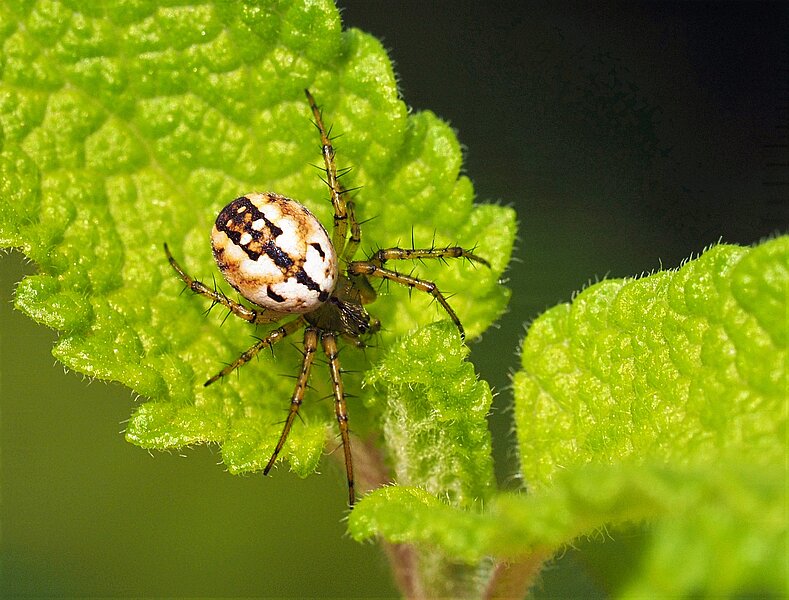
The body length of female Mangora acalypha is 4.5–6 mm, while males are slightly smaller at 3–3.5 mm. Both sexes are similar in coloration and markings. The cephalothorax is uniformly light yellowish or greenish-brown with a black margin and a black median stripe; the abdomen is whitish-yellow. The markings on the upper side of the abdomen are characteristic: they consist of three dark stripes—more precisely, three rows of black dots connected by longitudinal lines. Interpretations of these markings vary widely. In England they interpreted as having the shape of a cricket bat; hence the common name used here. Elsewhere, the pattern is considered either to be a series of simple stripes (German-speaking regions called it the “Streifenkreuzspinne”), or as resembling a small bottle (in France they refer to it as "mangore petite bouteille”).
Way of life
Mangora acalypha has a reproductive period from late spring to summer. Sexually mature spiders can be found from April to August. The female lays her eggs from about mid-May. The cocoon, made of white silk and 4–5 mm in diameter, encloses approximately 25 eggs. The spiderlings hatch in July and undergo their first moults; they overwinter in the soil in moss and leaf litter. In spring, the spiderlings moult further until they reach sexual maturity. The cricket-bat orb-weaver builds its webs both at the base of vegetation on low-growing plants in the herbaceous layer and on shrubs and bushes, usually in sunny, open habitats. The web, approximately 20–30 cm wide, is typically slanted with 40–60 spokes and a closed center (hub) made of very finely spun silk threads. The spider does not build a separate retreat and usually stays in the center of its web during the day. When disturbed, it drops to the ground on a silken thread or seeks shelter in the surrounding vegetation. Its diet consists primarily of small flying insects, such as mosquitoes and flies, that become trapped in the web.
Similar species
There are no similar species: the cricket-bat orb-weaver is easily recognizable by the unique markings on its abdomen.
Text: Christoph Hörweg & Norbert Milasowszky
The cricket-bat orb-weaver is common and widespread, and can therefore be found almost everywhere during walks and excursions in nature. And it's easy to recognize: not only is the spider itself unmistakable due to its characteristic abdominal pattern, but its web, with its high number of spokes and fine mesh center, is also easily distinguishable from the webs of other orb-weaving spiders. The selection of the Spider of the Year is not only intended to bring a less popular group of animals into the spotlight, but scientists also hope to gather data on its current distribution. So, keep your eyes peeled on your next walk and help document this species by reporting your sightings or taking a photo.
Coordination of the Spider of the Year is handled by the Natural History Museum Vienna, in cooperation with the Arachnologischen Gesellschaft (AraGes) and the European Society of Arachnology (ESA).
Countries involved
Albania, Austria, Belgium, Bulgaria, Croatia, Czech Republic, Denmark, Finland, France, Germany, Great Britain, Hungary, Ireland, Italy, Liechtenstein, Luxembourg, Macedonia, The Netherlands, Norway, Poland, Portugal, Serbia, Slovakia, Slovenia, Spain, Sweden, Switzerland
Supporting societies
- ARABEL - Belgische Arachnologische Vereniging
- ARAGES - Arachnologische Gesellschaft
- BAS - The British Arachnological Society
- CAS - Česká arachnologická společnost
- ESA - European Society of Arachnology
- GIA - Grupo Ibérico de Aracnología
- NATURDATA - Biodiversidade online (Portugal)
Contact for Europe
Dr. Milan Řezáč
Biodiversity Lab, Crop Research Institute
Drnovská 507
161 06 Praha 6 – Ruzyně
Czech Republic
reza(a)cvurv.cz
Distribution in Europe
- Verbreitung nach araneae Spinnen Europas
- in Österreich
- in Benelux-Ländern
- in Tschechien
- in Deutschland
- in Italien
- in der Schweiz
- in Frankreich
Wikis and Photo galeries
- Wiki des Spinnen-Forum
- Wikimedia commons
- araneae - spiders of Europe
- Pierre Ogers Galerie Arachno (Les araignées de Belgique e de France)
- Arachnologische Gesellschaft e.V. 2025 Atlas der Spinnentiere Europas (Arachnida: Araneae, Opiliones, Pseudoscorpiones, Amblypygi, Solifugae, Scorpiones, Schizomida) für Mangora acalypha – (link) (4.12.2025)
- Arachnologische Gesellschaft e.V. 2025 Wiki des Spinnen-Forums – (link) (4.12.2025)
- Bellmann H 2016 Der Kosmos Spinnenführer. Franckh-Kosmos Stuttgart. 429 S.
- Blick T, Bosmans R, Buchar J, Gajdoš P, Hänggi A, Helsdingen P van, Růžička V, Staręga W & Thaler K 2004 Checkliste der Spinnen Mitteleuropas. Checklist of the spiders of Central Europe. (Arachnida: Araneae). Version 1. Dezember 2004
- Blick T, Finch O-D, Harms KH, Kiechle J, Kielhorn K-H, Kreuels M, Malten A, Martin D, Muster C, Nährig D, Platen R, Rödel I, Scheidler M, Staudt A, Stumpf H & Tolke D 2016 Rote Liste und Gesamtartenliste der Spinnen (Arachnida: Araneae) Deutschlands. – In: Gruttke H, Balzer S, Binot-Hafke M, Haupt H, Hofbauer N, Ludwig G, Matzke-Hajek G & Ries M [Red.] Rote Liste gefährdeter Tiere, Pflanzen und Pilze Deutschlands, Band 4: Wirbellose Tiere (Teil 2). – Münster (Landwirtschaftsverlag). – Naturschutz und Biologische Vielfalt 70(4):383-510
- Breitling R, Merches E, Muster C, Duske K, Grabolle A, Hohner M, Komposch C, Lemke M, Schäfer M & Blick T 2020 Liste der Populärnamen der Spinnen Deutschlands (Araneae) – Arachnologische Mitteilungen 59:38-60. doi: 10.30963/aramit5907
- CSCF (Centre Suisse de Cartographie de la Faune) 2019 Fauna der Schweiz – Spinnentiere oder Arachniden (Skorpione, Pseudoskorpione, Spinnen, Weberknechte, Milben) – (link) bzw. Verbreitungskarte für Mangora acalypha: (link) (4.12.2025)
- Hänggi A, Stöckli E & Nentwig W 1995 Lebensräume mitteleuropäischer Spinnen. Charakterisierung der Lebensräume der häufigsten Spinnenarten Mitteleuropas und der mit diesen vergesellschafteten Arten – Miscellanea Faunistica Helvetiae 4:1-459
- Jocqué R & Dippenaar-Schoeman AS 2006 Spider families of the world. Musée Royal de l'Afrique Central Tervuren, 336 pp.
- Nentwig W, Blick T, Bosmans R, Gloor D, Hänggi A & Kropf C 2025 araneae – Spiders of Europe, version 12.2025 – (link) (04.12.2025). doi: 10.24436/1
- Reichholf JH & Steinbach G 1997 Die grosse Enzyklopädie der Insekten, Spinnen und Krebstiere, Band 1. Bertelsmann Lexikon Verlag Gütersloh. 360 S.
- Thaler K & Knoflach B 2003 Zur Faunistik der Spinnen (Araneae) von Österreich: Orbiculariae p.p. (Araneidae, Tetragnathidae, Theridiosomatidae, Uloboridae). Linzer Biologische Beiträge 35/1:613-655
- World Spider Catalog 2025 World Spider Catalog, version 26. Natural History Museum Bern – (link) (4.12.2025) doi: 10.24436/2